
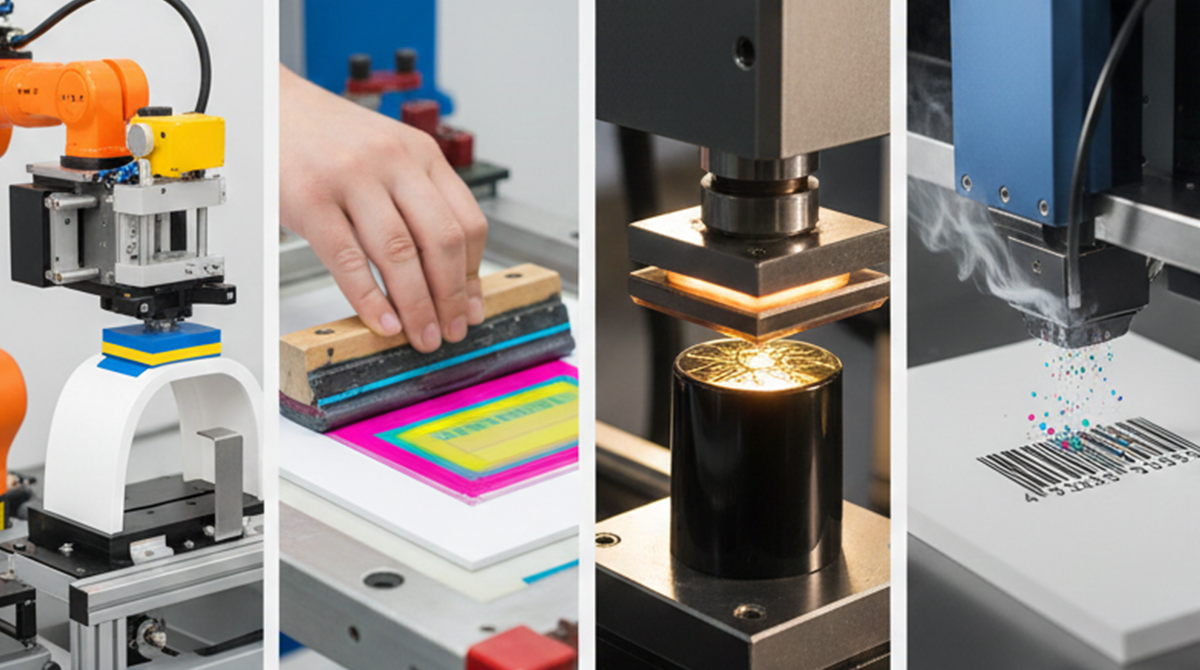
You are a plastic pen manufacturer. You produce 50,000 pens daily and print a logo on each one. Current method: Manual pad printing, cost 0.85 TL/unit. Automatic system: 0.40 TL/unit. Difference: 0.45 TL x 50,000 = 22,500 TL/day = 6,750,000 TL/year (300 working days).
Automatic system CAPEX: 2,800,000 TL. Payback: 4.9 months.
This calculation shows why printing technology selection is not just a matter of “quality”. Right method + right automation level = direct profit margin impact.
Printing Technologies: Method Comparison
There are 5 main technologies in plastic and metal part decoration:
| Technology | Process | Optimal Use | Cost Structure | Advantages | Disadvantages |
|---|---|---|---|---|---|
| Pad Printing | – Silicone pad picks up ink from plate – Transfers to 3D surface – Indirect offset process | – Small–medium detail (0.1–100 mm²) – Curved / irregular surfaces – 1–4 colors – Medium–high volume (5,000–100,000+/day) | – Manual: 150,000–400,000 TL – Semi-automatic: 600,000–1,200,000 TL – Fully automatic: 2,000,000–3,500,000 TL – Unit cost: 0.15–0.85 TL | – Adaptable to 3D geometries – Low setup cost (500–1,500 TL) – Quick color change (15–30 min) | – Low speed (600–1,200/hour) – 5–10% ink loss – Operator dependent |
| Screen Printing | – Ink transfer through mesh screen – Direct process – Stencil-based | – Large area (>100 mm²) – Flat / slightly curved surfaces – Solid designs – Very high volume (50,000+/day) | – Manual: 80,000–200,000 TL – Semi-automatic: 400,000–900,000 TL – Rotary: 3,000,000–6,000,000 TL – Unit cost: 0.08–0.35 TL | – Lowest unit cost – Thick ink layer → vibrant colors – High durability | – High setup cost (2,000–5,000 TL) – Slow color change (45–90 min) – Not 3D compatible |
| Hot Stamping (Foil Printing) | – Heated die + foil – Heat + pressure transfer – Dry process (no ink) | – Metallic / glossy effect – Flat & gentle curve surfaces – Luxury/premium products – Low–medium volume (1,000–20,000/day) | – Pneumatic: 300,000–700,000 TL – Servo: 1,200,000–2,500,000 TL – Unit cost: 0.25–1.20 TL | – Premium appearance (gold, silver, holographic) – High durability – Fast cycle time (2–5 sec) | – Only flat / gentle curve – High foil cost (15–40 TL/m²) – High die cost (3,000–15,000 TL) |
| Digital Printing (Inkjet / UV Digital) | – Drop-on-demand inkjet – No-contact direct printing – Variable data | – Personalization – Low volume, high variety – Full-color complex graphics – Prototype (100–5,000 pieces) | – Entry: 800,000–1,500,000 TL – Industrial: 3,500,000–8,000,000 TL – Unit cost: 0.40–2.50 TL | – Zero setup cost – Instant format change – Photo-quality (1200+ dpi) – Variable data | – High unit cost – Low throughput (1,000–5,000/hour) – Limited substrate compatibility |
| Laser Marking | – Focused laser beam – Ablates/engraves surface – Permanent marking | – Serial number – Barcode / QR code – Medical & automotive traceability – All volumes | – Fiber: 1,200,000–3,000,000 TL – CO₂: 800,000–2,000,000 TL – Unit cost: 0.05–0.20 TL | – No consumables – Permanent – 0.01 mm precision – No-contact | – Monochrome only – Variable contrast on plastics – Slow detailed marking (20–60 sec) |
Method Selection: Decision Matrix
Low Volume
(<5,000 units/day)
(<5,000 units/day)
1st Choice: Digital Printing
- No setup cost, variable data
- Unit cost 0.40-2.50 TL tolerable
- Low CAPEX (150,000-400,000 TL)
- Only option for curved surfaces
Medium Volume
(5,000-50,000 units/day)
(5,000-50,000 units/day)
1st Choice: Automatic Pad Printing
- Sufficient throughput (3,000-8,000 units/hour)
- Optimized unit cost (0.15-0.40 TL)
- Fast cycle time
- Durability
High Volume
(>50,000 units/day)
(>50,000 units/day)
1st Choice: Automatic Screen Printing
- Lowest unit cost (0.08-0.15 TL)
- Throughput 10,000-30,000 units/hour
- Continuous roll (for packaging)
- Unlimited throughput
Technology Trend Analysis: 2024-2027
Trend 1: UV Digital Printing Costs Declining
2020: Industrial UV inkjet system = 8,000,000+ TL 2024: Entry-level system = 800,000 TL 90% price reduction
Impact:
- Digital is now economical for low volume (<5,000 units/day) applications
- Customization demands are increasing (each unit different)
- Prototype-to-production transition accelerating
Recommendation: If you produce customized products, re-evaluate digital systems.
Trend 2: Price/Performance Improving in Automatic Pad Printing Systems
Servo-driven systems:
- Cycle time: 4-6 seconds in 2018 → 2-3 seconds in 2024
- Positioning accuracy: ±0.05 mm → ±0.01 mm
- Price: 15-20% decrease (Chinese manufacturers competing)
Impact:
- ROI improved for automatic pad printing in medium volume (10,000-50,000 units/day) applications
- Payback period: 5-7 years → 2-4 years
Recommendation: If you decided on manual pad printing 3+ years ago, recalculate.
Trend 3: Laser Marking Technology Becoming Widespread
Fiber laser prices:
- 2018: 3,000,000+ TL
- 2024: 1,200,000 TL
- 60% price reduction
Impact:
- Laser marking becoming standard in sectors with increasing traceability requirements (medical, automotive, electronics)
- Zero consumable advantage very economical in long term
Recommendation: If you print serial numbers/barcodes and your volume is >10,000 units/day, consider switching to laser.
Conclusion: Method Selection = Profit Margin Optimization
Printing technology selection is not an aesthetic decision – it’s a financial decision. Wrong method:
- Can increase unit cost by 50-200%
- Can create throughput bottleneck
- Can lead to quality inconsistency
Right method:
- Optimizes cost
- Maximizes throughput
- Standardizes quality
Before deciding: Conduct detailed ROI analysis. Payback less than 3 years = justifies investment.